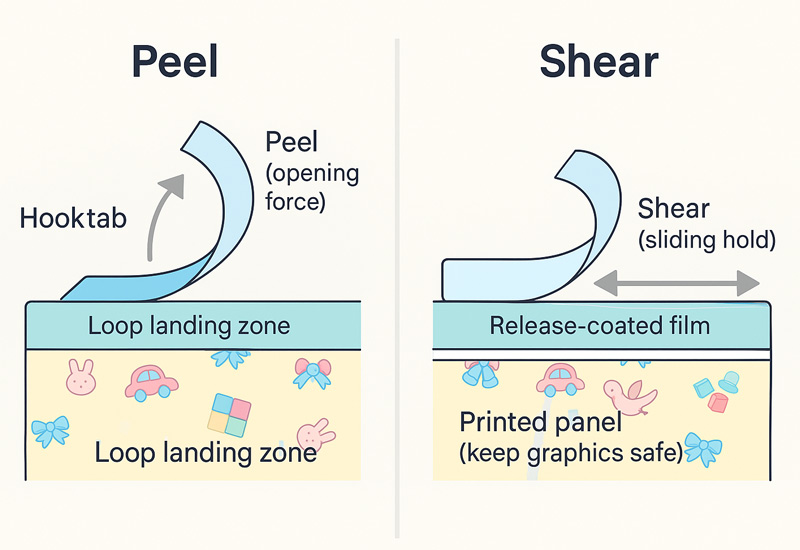
Peel: how hard it is to lift the tab off the landing zone.
Shear: how well the closure resists sliding under load over time.
You want high shear (so it doesn’t creep or sag) and moderate peel (so you can reopen without yanking ink). Hit that balance and you keep the print fresh. Miss it and you get silvering, whitening, or even film lift.
The two closure paths (and what they do to prints)
Hook & loop with a loop landing zone
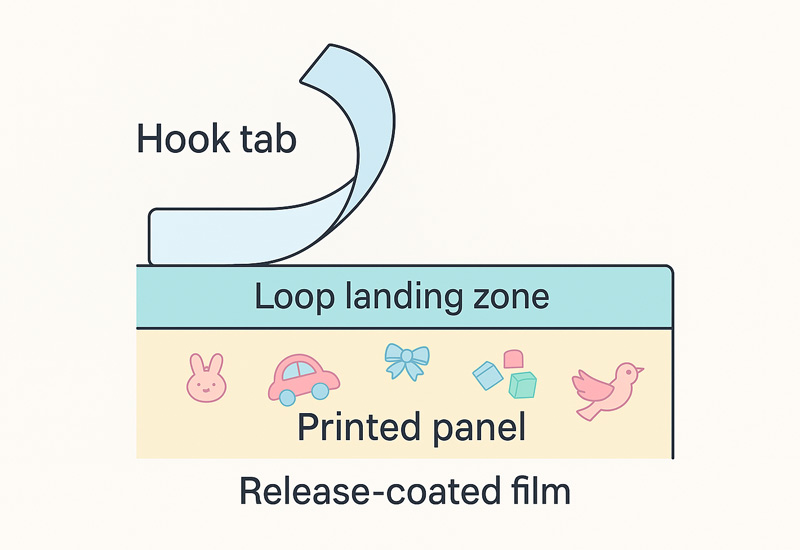
Hook tabs into a loop panel are naturally re-close friendly. The loop fabric is the sacrificial layer, not your printed film. If you run ABDL designs with glossy graphics, this setup is forgiving. It also plays nice with wetness indicators because you can land the tabs on the loop, not the printed area.
Adhesive tabs with a release-engineered film
Adhesive works great too—if you pair it with a release-coated frontal film (often silicone-coated BOPP). The coating lets you unstick and restick without ripping color. Don’t plant adhesive straight on raw printed film. That’s how you scuff. It do damage, fast.
Quick “why it matters” table
Decision point
If you choose this
What it protects
Risk if mismatched
Operator note
Tab type
Hook tabs
Printed film (ink sits safe behind loop)
Hook landing on smooth film → weak hold
Check hook density vs loop grade
Landing zone
Loop panel
Refastening cycles
Adhesive onto bare print → ink lift
Keep loop edge aligned, no overhang
Frontal film
Release-coated BOPP
Clean peel, lower ink stress
Uncoated film → noisy peel, scuff
Replace rolls if coating wear
Test focus
Shear priority
No night-time creep
Over-peel → hard to open
Tune to “high shear / moderate peel”
Re-tape flow
On-zone every time
Graphics, wetness marks
Off-zone → delam spots
Train: “on the zone, every time”
Field-tested flow
Aim for the zone. Tabs always land on the loop panel or the release frontal. Not the printed panel.
Press, then slide a hair. Micro-slide seats the tab for shear. Tiny move, big win.
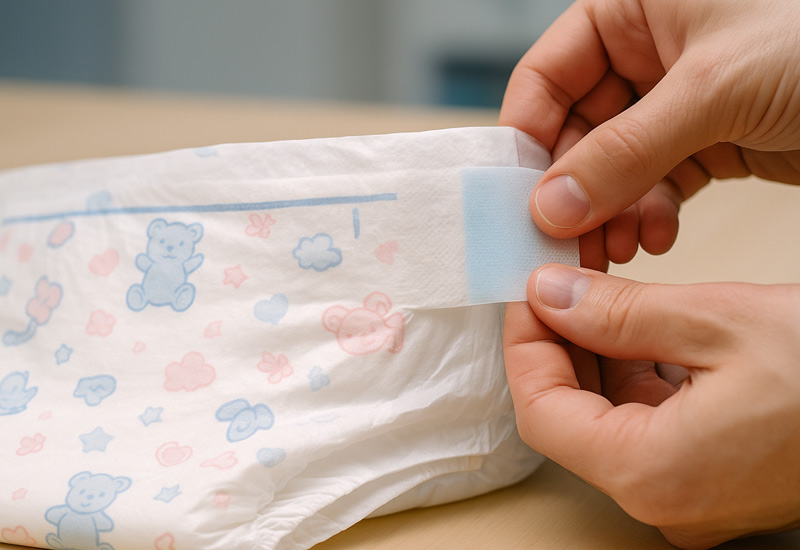
To reopen, peel in-plane. Don’t yank straight up. Peel low and slow, in the direction of the tab, not perpendicular.
Re-press after adjustment. Two quick knuckle presses. Shear loves surface area.
If it squeals, stop. Noisy, jerky peel = coating too “grabby.” Swap roll or reduce tab pressure.
QC toolbox
Test
What it checks
Why you care
Good outcome looks like
If it fails
90° peel (closure)
Opening feel
Re-tape without shock to ink
Steady, not spiky; no film whitening
Shift to lower-tack or better frontal
135° peel (closure)
Edge-case peel path
Catch worst-case angles
Smooth release; no “snap”
Change angle spec or tab cut
Moving shear
Long hold under load
Stops “tab creep” at night
No drift over the dwell window
Bump shear; keep peel moderate
Cross-hatch tape (print)
Ink adhesion on film
Predicts print lift
Grid stays put after pull
Change ink/primer/cure
Hand re-tape cycles
Real user abuse
Validates loop or release film
Clean multiple re-tapes
Upgrade landing surface
The pattern is what matters: shear up, peel reasonable, ink stays.
Troubleshooting
Symptom
Likely cause
Fast fix
Longer fix
Print scuffs on first reopen
Adhesive on raw print
Land on zone, not print
Add release-coated frontal
“Pop-open” after movement
Low shear
Press harder / micro-slide
Change to higher-shear spec
Loud peel + color ghosting
Over-tacky tab / tired film
Lower tab pressure
New frontal roll / new coating
Loop fuzzing out
Hook too aggressive
Shift hook density
Denser loop grade
Tabs drifting overnight
Poor shear / humidity
Add second press
Re-spec tab adhesive window
Scenarios you’ll see
High-coverage ABDL prints, glossy look: Go hook + loop. Your art lives behind the loop. Shear is great. Peel is gentle. Want to see our patterns? Tap ABDL Diapers for style options and panel layouts.
Adhesive workflow, clean front look: Keep adhesive tabs, but add release-coated BOPP as the landing zone. You get the smooth face, and re-tapes don’t chew the ink. For a ready-to-run build, check Leak-Proof ABDL Diaper for Adult Men and Women — a practical reference point for tab behavior and panel zoning.
Users who re-adjust a lot (comfort fit, photos, etc.): Bias to loop. It’s forgiving. It’s quiet. It’s repeatable. Explore styles under ABDL Diapers if you want bigger landing zones for heavy re-tapers.
Moisture or lotion on hands: Adhesive tabs can get temperamental. Hook & loop keeps performing. If you stay adhesive, train peel-in-plane and keep fingers clean/dry.
Bedtime long dwell: Favor shear. Two quick presses. Check for even tension on both hips. If you see drift, re-land the tabs on-zone, not higher up on the print.
Mini case snapshot
A brand shipped an adhesive-tab design straight onto a printed BOPP. Open once, fine. Second open, white scuffs across the dragon graphic. Fix was simple: swap in a release-coated frontal and retrain “peel low and slow.” Scuffs gone, returns down. Graphics look new after multiple re-tapes.
Build choices through the lens of “print safety”
Tab type is not a religion. Hook/loop or adhesive both work if you respect the correct landing zone.
Landing zone is the hero layer. It takes the hit so the art doesn’t.
Operator habit beats spec sheets. On-zone landing and in-plane peel do more than any brochure number.
ABDL prints are part of the product. Treat them like a feature, not decoration. Protect them like you protect fit and absorbency.
Where Lovinhug fits
You want a partner that builds with print safety in mind. Lovinhug is an ABDL Diapers manufacturer and ABDL Diapers factory with ISO 13485 mindset, CE and FDA support, and FSC materials options. We do OEM/ODM for private-label partners across North America, Europe, MENA, SEA, LATAM, and Oceania. That means:
Design for re-tape: loop panels sized right, release films where needed, clean edges so users can find the zone by feel.
Closure tuning: we prioritize shear, keep peel user-friendly, and validate with practical hand-cycle checks.
Print stack control: inks, primers, cure—tied to the landing-zone plan, not treated as an afterthought.
Fast sampling and straight talk: you get a working sample quickly; we iterate with operator notes, not wishful thinking.
Print stack adhesion screened with a tape-pull method
Final inspection includes hand re-tape cycles
Labels reflect care tips (“land tabs on the frontal zone please”)
Extra tips for home users
Re-tape on the zone. If you can’t find it in the dark, feel for the softer loop or the slightly slick frontal.
Peel low, not up. Think “roll off,” not “rip off.”
Dry hands. Lotion or sanitizer will mess with adhesive tabs.
No tug-of-war. If it fights you, pause. Press, then peel from the corner.
Final word
Strong tabs are great. Smart re-tapes are better. Protect the print, and the whole product feels premium longer. You can feel the difference when you open, adjust, and close. So can your customers.
Questions or ready to prototype? Welcome to fill the Lovinhug contact form, and we’ll reply fast.